New gTLD application round: the domain world has changed
More than a decade has passed since the internet saw its biggest ever expansion of domain extensions. In 2012, ICANN opened the application window for new generic top-level domains, better known as gTLDs. Until then, the internet had been dominated by a relatively small set of familiar endings, such as .com, .net and .org, alongside country-code domains like .ee or .lv. Now, the domain world is preparing for the next major gTLD round – but this time, things are different. The market is more mature, expectations are more realistic, and the success of new domain extensions will depend far more on a clear strategy than on a big idea alone.
2012 changed the domain world
The 2012 expansion changed the domain landscape completely. Suddenly, companies, cities, organizations and investors could apply for almost any domain extension imaginable. It marked the beginning of the era of .xyz, .guru, .app, .shop, .berlin and hundreds of other new endings. There was enormous excitement around the program, and for a moment it felt as if the domain industry was entering an entirely new chapter.
The numbers alone show how ambitious the project was. Nearly 2,000 applications were submitted during the round, and more than 1,200 new top-level domains were eventually delegated and launched. Not every application made it across the finish line. Some were rejected, some were withdrawn, and many ended up in costly contention battles where several applicants wanted the same extension. In a number of cases, the right to operate a TLD was decided through auctions worth millions of dollars.
Big expectations did not guarantee a big breakthrough
At the time, many believed the internet would quickly move beyond .com. There was a feeling that businesses and users would increasingly adopt more descriptive and specialized domain endings.
In some cases, that did happen. For example, .xyz became widely recognized, especially in the technology sector, while .app gained popularity thanks to strong branding and built-in HTTPS requirements. Geographic extensions such as .berlin also found their audience by helping create a stronger regional identity online.
But the reality turned out to be more complicated than many had expected.
A large number of new top-level domains struggled to gain real traction after launch. Some saw fairly good registration numbers at first but failed to build long-term usage. Others never found a clear identity or target audience. Marketing costs proved to be much higher than expected, and many registry operators quickly realized that launching a new domain extension was only the first step. Convincing businesses and users to actually adopt it was a completely different challenge.
.com and local domains remained strong
Meanwhile, .com remained dominant, and strong country-code domains continued to perform extremely well in their local markets. Even today, for most businesses, a trusted local country-code domain such as .ee or .fi – or the classic .com – still feels like the safest and most recognizable choice.
Now, the domain industry is preparing for the next major round of gTLD applications, expected to open in 2026. Yet the atmosphere around this upcoming round feels very different from the optimism and high expectations of 2012.
Back then, the program had something of a gold rush feel. This time, the market is far more mature.
The next round will be more strategic
One reason is experience. The previous application round gave the industry valuable insight into what works and what does not. It clearly showed that simply launching a new domain extension is not enough. A successful top-level domain needs a clear purpose, a defined audience, strong distribution channels, and long-term investment and commitment behind it.
That is why the next application round is expected to be far more strategic.
Instead of hundreds of speculative ideas, we are likely to see more carefully considered applications tied to specific industries, communities or brands. Large companies may apply for their own brand-based top-level domains not necessarily because they want millions of registrations, but because they want more control over their digital ecosystems and online identity (for example, the .google extension registered in 2014).
Cities and regions may continue to use geographic top-level domains to strengthen their local digital brands. At the same time, niche industries may experiment with specialized domain spaces that have clear use cases and practical value.
New technologies may inspire new domain extensions
There is also growing interest in how emerging technologies and online trends could influence future applications. Artificial intelligence, cloud infrastructure, digital identity, cybersecurity, aviation, fintech and creator platforms are all areas where targeted domain extensions could make real sense.
Instead of trying to become the next .com, future top-level domains may focus on serving smaller but more active and highly engaged communities.
The rules are becoming stricter
Another major difference is regulation. ICANN has spent years refining the rules based on lessons learned from the previous round. Background checks, rights protection mechanisms and consumer safeguards are expected to be stronger this time.
The organization is also likely to take a stricter stance on so-called closed generic top-level domains. This means applicants may face limitations if they want exclusive control over highly generic terms.
Creating a top-level domain requires serious investment
The cost of applying also ensures that the next round will remain a serious undertaking. Applying for a top-level domain is not just about paying the application fee, which alone is expected to exceed 200,000 dollars. Applicants also need legal expertise, technical infrastructure, compliance systems and long-term operational planning.
In practice, launching a top-level domain can easily require investments reaching hundreds of thousands or even millions of euros.
Because of this, the next application round may turn out to be smaller than the 2012 round in terms of total application numbers. But smaller does not necessarily mean less important. In many ways, this round may produce stronger and more sustainable projects precisely because applicants now understand the market far better.
New domains will still take time
At the moment, none of the new domain extensions from the upcoming round are available for registration yet. Even after the application window opens, the evaluation and delegation process will likely take years. This means the first new domains may not go live before 2028 or even later.
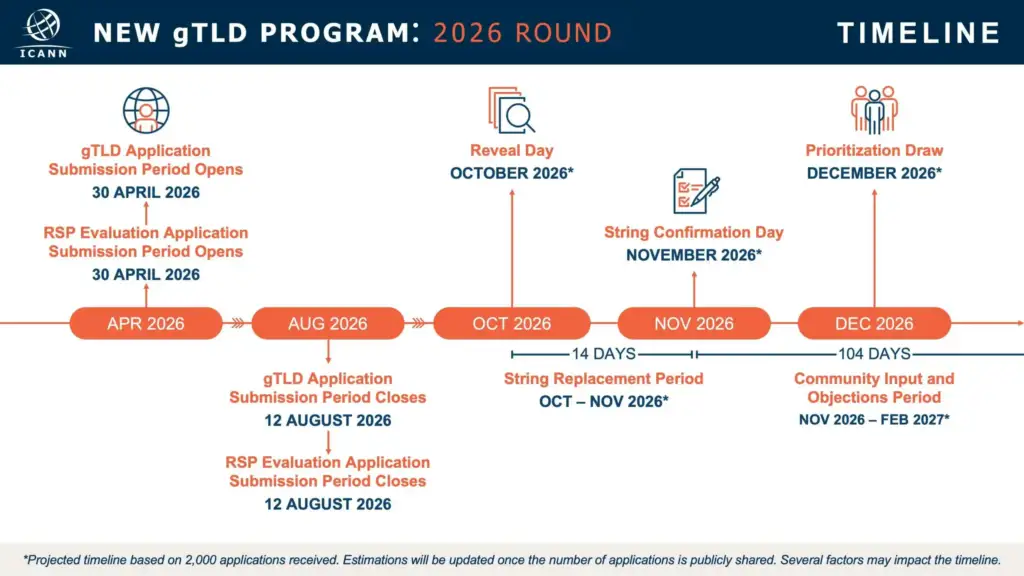
For registrars, hosting providers and companies already active in the domain industry, however, the preparation phase has already begun. The next few years will likely shape which ideas become the next generation of internet identities and which remain only concepts on paper.
Less hype, more substance
The next gTLD application round may not create the same explosive excitement as 2012, but it could turn out to be far more meaningful.
The first major expansion proved that the internet could support much greater diversity in domain names. The next one will test whether that diversity can evolve into something truly sustainable.
Popular posts

Oh Dear – a simple way to truly understand how your website is doing

Zone and Patchstack: a partnership that takes WordPress security to the next level

PHP 8.5 now officially released